
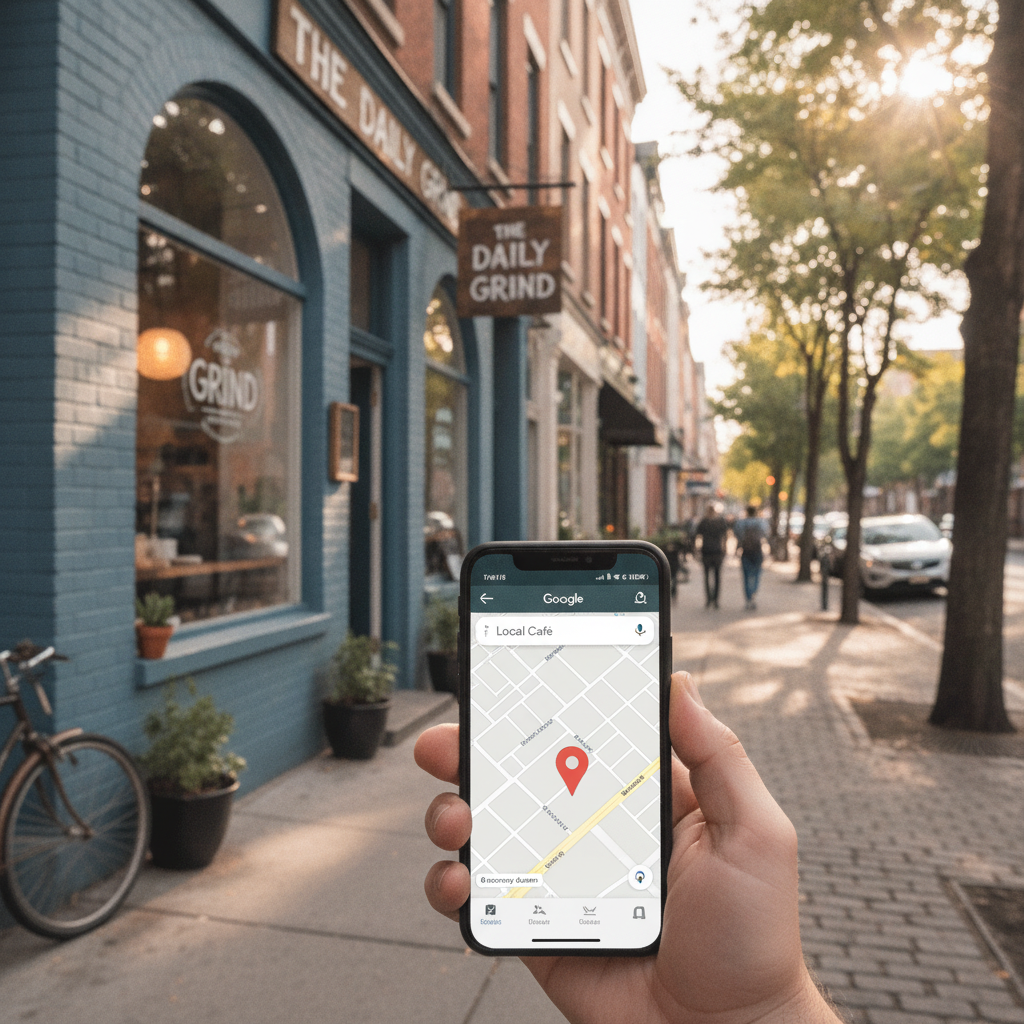
If your business depends on customers who live, work, or drive within a few miles of you — a dental practice, a plumbing company, a boutique, a law firm — then local SEO is one of the highest-leverage marketing activities you can do. And it's also one of the most tedious.
That's where AI fits in. Not as a magic ranking button, but as a tool that handles the repetitive, time-consuming parts of local SEO so you can actually keep up with them.
Here's a grounded look at where AI helps, where it doesn't, and what to avoid so you don't invite a Google penalty.
What Local SEO Actually Involves (And Why It Dies on the Vine)
When someone searches "emergency plumber near me" or "best pediatric dentist in [city]," Google decides who shows up based on a handful of factors: how complete and accurate your Google Business Profile is, how relevant your website content is to local searches, how many recent reviews you have, and whether other local sites link to or mention you.
The problem isn't that any of this is complicated. The problem is that it's continuous. You have to keep your profile updated, respond to every review, publish fresh local content, and research the actual phrases your customers are typing — not the phrases you think they're typing. Most small business owners do this inconsistently, or not at all, because they're running a business.
AI doesn't make local SEO effortless. But it dramatically lowers the time cost of doing it consistently.
Four Places AI Actually Helps
1. Keeping Your Google Business Profile Fresh
Your Google Business Profile (GBP) — the card that appears on the right side of Google search results and on Google Maps — is probably the single most important local SEO asset you have, and most businesses underuse it.
Google rewards profiles that are active. That means posting updates, adding photos, keeping your hours accurate (including holidays), and using the Q&A section. In practice, most owners update their GBP once and forget it.
AI tools like ChatGPT, Claude, or Gemini can generate a month's worth of GBP posts in an hour. You describe your business, your seasonal promotions, your services, and your location, and you ask for short, local-flavored posts. You edit and approve; the AI drafts. A 20-minute session can fill your posting calendar for a month.
What to watch: Don't publish AI drafts verbatim without a read-through. Generic posts ("We're excited to serve our community!") don't help. Push the AI to be specific: mention the neighborhood, the season, the specific service, the real benefit.
A prompt that works:
"Write a 150-word Google Business Profile post for a family-owned HVAC company in Raleigh, NC, promoting furnace tune-ups heading into fall. Friendly tone, no fluff, end with a call to book online."
2. Finding the Search Terms Your Nearby Customers Actually Use
Keyword research for local SEO has a specific problem: the most obvious terms ("dentist," "plumber," "lawyer") are dominated by directories like Yelp and Healthgrades. The terms that actually convert for a local business are more specific — and harder to guess.
AI tools can help you brainstorm a much longer list of variations than you'd come up with yourself. Think: service + city, service + neighborhood, service + "near me," problem-based searches ("why does my furnace smell like burning"), and comparison searches ("HVAC service contract vs pay per visit").
From there, you can run those terms through a free tool like Google Search Console (if your site is already set up) or Google's free keyword planner to see which ones have actual search volume. AI generates the list; the data tells you which ones to prioritize.
Try this:
"I run a family law firm in Scottsdale, AZ. Give me 30 search terms a potential client might type into Google when looking for a divorce attorney, child custody help, or mediation. Include neighborhood-level and problem-based variations."
You'll get terms your marketing agency might have missed, because you can give the AI the kind of local and operational context only you have.
3. Drafting Location-Relevant Content for Your Website
Google wants to see that your website is genuinely about your service area — not just that you exist there, but that you're embedded in it. That usually means having service area pages (a page for each city or neighborhood you serve) and locally relevant blog content.
This is a genuine content opportunity that most small businesses ignore because writing takes time. AI makes it possible to produce these pages without hiring a full-time copywriter.
A well-structured service area page might cover: what services you offer in that location, how long you've served that area, anything specific to that market (seasonal considerations, local regulations, common local problems), and a call to action. AI can draft this in minutes if you give it the right inputs.
What to include in your prompt:
- The specific city or neighborhood
- Your services and what makes them different
- Any local context (e.g., "Phoenix summers mean AC systems run almost year-round")
- The tone you want (professional, warm, direct)
The content still needs your review. AI will occasionally hallucinate a fact or produce something generic. You're the editor; the AI is the first draft.
4. Responding to Google Reviews (Without Sounding Like a Robot)
Reviews are a local SEO ranking factor, but they're also the thing most business owners dread managing. A five-star review deserves a warm acknowledgment. A two-star review about a misunderstanding deserves a careful, professional response that doesn't make things worse.
AI can draft both. You paste in the review text, give the AI some context about your business and what happened (if it was a complaint), and ask for a response draft. You tweak the draft, then post it.
This matters because the businesses that consistently respond to reviews — positive and negative — outperform those that don't, both in rankings and in the perception of new customers reading those reviews. The bottleneck isn't knowing what to say; it's making time to say it. AI removes that bottleneck.
For negative reviews specifically: give the AI explicit guidance to avoid being defensive, to acknowledge the experience, and to offer a path to resolution offline. Don't let it apologize for things that didn't happen or make promises your business can't keep.
This is one of those areas where we often help clients build a simple, repeatable review response process — consistent enough to be sustainable, personalized enough to be genuine.
What AI Won't Do (And Shouldn't)
A few things worth being direct about:
AI can't build links for you. Backlinks from other local websites — a chamber of commerce, a local news site, a partner business — are still a significant ranking factor, and no AI tool can manufacture those. That's relationship work.
AI can't fix a bad profile foundation. If your business name, address, and phone number are inconsistent across Google, Yelp, and your website — what's called NAP consistency — AI-generated content won't help much until that's cleaned up.
AI can't replace actual reviews. You still have to earn them. AI can help you ask for them (drafting a follow-up email or text to satisfied customers), but the relationship that generates the review is yours.
The Tactics That Will Get You Penalized
This is worth spending a minute on, because bad advice is common and the downside is serious.
Don't stuff AI-generated content with keywords. A service area page that reads like "Plumber Scottsdale AZ plumbing services Scottsdale AZ emergency plumber Scottsdale AZ" is exactly what Google's spam algorithms are trained to catch. It also repels human readers. Density is not the goal; relevance is.
Don't create fake service area pages. If you don't actually serve a city, don't create a page for it. Google has gotten very good at detecting thin, templated pages for locations a business has no real connection to.
Don't generate and publish hundreds of pages at once. A sudden explosion of low-quality AI content is a red flag. Build out location pages gradually, make sure each one is genuinely useful, and review them before they go live.
Don't fake reviews or pay for them. This is a Google Terms of Service violation and can get your profile suspended. AI can help you ask for reviews; it can't ethically help you manufacture them.
The underlying principle: AI should help you do real SEO faster, not help you fake SEO entirely.
A Realistic Starting Point
If you're a local business owner who wants to start using AI for local SEO without overcomplicating it, here's where to start:
- Audit your Google Business Profile. Make sure it's complete, accurate, and has photos. This takes 30 minutes and costs nothing.
- Set up a monthly GBP posting habit. Use AI to draft four posts at the start of each month. Block an hour. Schedule them.
- Build a local keyword list. Spend an afternoon with an AI tool generating search term variations, then check them in Google Search Console or Keyword Planner.
- Write one service area page per month. If you serve five cities, you'll have a full set in five months. Review every draft before it goes live.
- Respond to every review within a week. Use AI to draft; use your judgment to post.
None of this is glamorous. All of it compounds over time. Businesses that do it consistently beat businesses that don't — and AI makes "consistently" a much more realistic bar.
If you're not sure where your local SEO actually stands, or you want help figuring out which of these moves would make the biggest difference for your specific business, book a strategy call with us. We'll take a look at what you've got and tell you honestly what's worth your time.