

The AI Consulting Market Has a Credibility Problem
Spend twenty minutes on LinkedIn and you'll find hundreds of people who became AI experts sometime around late 2022. They offer "AI transformation," "intelligent automation at scale," and "next-generation workflows"—usually for a substantial retainer, usually with a slide deck full of ChatGPT screenshots.
Meanwhile, business owners who actually need help—automating a real process, figuring out whether a particular tool is worth buying, building something that connects to their existing systems—are left trying to tell the signal from the noise.
This article is my attempt to give you a practical filter. These are the questions worth asking any AI consultant or vendor before you sign anything, along with the answers that should give you confidence and the ones that should send you looking elsewhere.
Fair warning: Blueprint AI Strategy is itself a consulting firm. I'm writing this anyway, because the credibility play isn't pretending the conflict doesn't exist—it's being honest about it and holding ourselves to the same standard.
Start With the Right Mental Model
Before the questions, a framing that helps: the best AI consultants are translators, not magicians.
Their job is to understand your business well enough to identify where AI can actually help, explain the tradeoffs clearly, help you implement something that works with your existing tools and data, and tell you when it's not worth doing. That's a relatively unglamorous description of a valuable service.
Anyone positioning themselves primarily as a technology visionary or an innovation catalyst—rather than someone who solves specific business problems—is probably selling something you don't need.
Questions to Ask — and What Good Answers Look Like
"Can you describe a specific problem you solved for a business similar to mine?"
This is your first filter, and it's a blunt one. You're not looking for an industry case study with no numbers or a vague story about "driving efficiency." You're looking for: the company type, the actual problem (e.g., "their customer service team was spending 40% of their time answering the same twelve questions"), what was built or implemented, and what actually changed.
Good answer: Specific, a little boring, honest about what worked and what didn't.
Red flag: A portfolio of logos with no stories behind them, or a single case study that conveniently applies to every industry.
"What does this not work well for?"
Any consultant who can't answer this question readily is either inexperienced or not being straight with you. Every AI tool has genuine limitations—hallucination risks, data requirements, latency issues, cost curves that don't make sense below a certain volume. A good consultant knows these cold and volunteers them upfront.
Good answer: "For a business your size, a custom-trained model is almost certainly overkill and you'd spend six months on a project that an off-the-shelf tool handles in a week. Here's when custom training actually makes sense…"
Red flag: Every question about limitations pivots back to the benefits. Or worse: "The technology has advanced so much that most of the old concerns don't really apply anymore."
"How does this connect to the systems and data we already have?"
This is where a lot of AI projects quietly die. The demo works beautifully in isolation. Then someone asks how it connects to your CRM, your ERP, your existing customer data—and suddenly there's a long pause and talk of "an integration phase."
Before you engage anyone, you should understand what data this system needs to do its job, where that data currently lives, what it will take (technically and in terms of cost) to connect them, and who maintains that connection when something breaks.
Good answer: A frank conversation about your current systems early in the process, specific questions about your data formats and APIs, and an honest scoping of integration work as a distinct line item.
Red flag: Integration treated as an afterthought, or a proposal that assumes your data is "ready to use" without asking what it looks like.
"What does the engagement look like after the initial build?"
AI systems aren't set-and-forget. Models drift. Business processes change. The thing you built for last year's workflow may need adjustments when you hire ten people or switch your CRM. Any vendor or consultant who doesn't address this is either planning to sell you an expensive support contract later, or planning to disappear.
Good answer: A clear description of what's included, what's not, what typical maintenance looks like over the first year, and what it would take for your internal team to manage it without them.
Red flag: No exit plan. No documentation. No transition plan that doesn't involve them indefinitely.
"How will we know if this is working?"
This sounds obvious. It rarely gets asked. Before work starts, you should agree on the specific metric that defines success—not "improved efficiency" but "reduced average handle time from 8 minutes to 5 minutes" or "cut first-draft writing time by 60%." If a consultant resists defining success in concrete terms, that's meaningful information.
Good answer: "Let's work backward from what success looks like for your business, then figure out how to measure it before we start."
Red flag: Success defined entirely in activity metrics (number of prompts processed, workflows automated) with no connection to business outcomes that matter to you.
The Red Flags Worth Walking Away From
Some things are disqualifying on their own:
Guaranteed outcomes. No ethical practitioner guarantees specific ROI on an AI project before doing the diagnostic work to know what's actually possible. If someone guarantees a 3x return before they've looked at your data and your processes, they're selling you something.
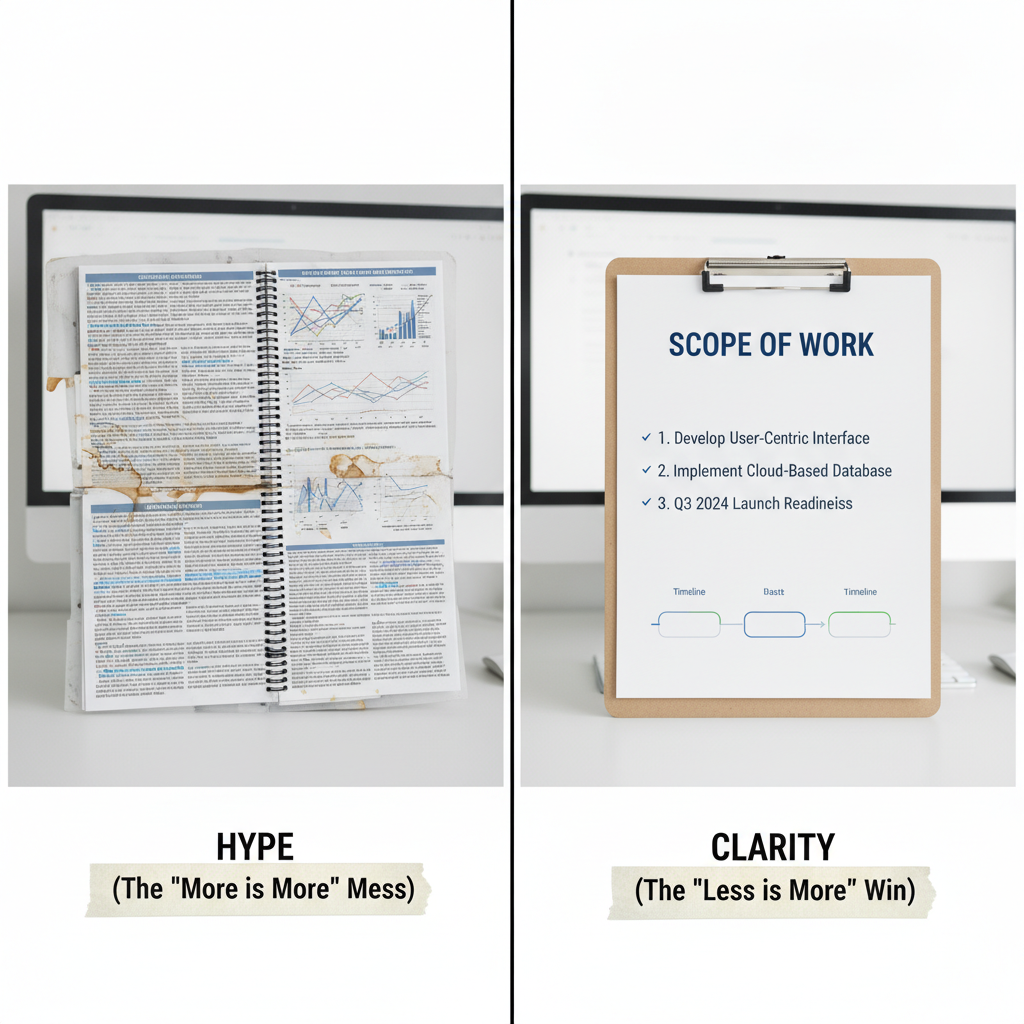
Jargon as a substitute for specifics. "Leveraging large language models to drive intelligent automation across your customer journey" tells you nothing. If you ask what that actually means for your business and get more jargon back, walk away. Clarity is a professional obligation, not a nice-to-have.
No interest in your data. AI tools are only as useful as the data they work with. A consultant who doesn't ask hard questions about your data—where it lives, how clean it is, how much of it exists, who owns it—either doesn't know what they're doing or is about to sell you something that won't work in your actual environment.
Pressure to move fast. "We only have two spots left this quarter" is a sales tactic, not a reason to skip due diligence. Good consultants with full pipelines don't need to manufacture urgency.
One-size-fits-all proposals. If the proposal you receive looks like it could have been sent to twenty other companies with light customization, it probably was. Your business is specific. The approach should be too.
What a Reasonable Engagement Actually Looks Like
For most small-to-midsize businesses, a legitimate AI engagement starts with a diagnostic phase—sometimes called a discovery or audit—before anyone commits to building anything. This is where a good consultant learns how your business actually operates, identifies where AI would create real value versus where it's a solution in search of a problem, and gives you an honest recommendation even if that recommendation is "not yet" or "not this."
That diagnostic phase should produce a clear document: what the opportunity is, what it would take to pursue it, what the expected impact is and how you'd measure it, and what the risks are. From there you decide whether to proceed.
This is the kind of diagnostic work we do with clients before recommending any specific tool or build. We'd rather tell someone their data isn't ready and come back in six months than take a project that won't deliver.
The Bar to Hold Us To
Since I said I'd apply this standard to Blueprint AI Strategy as well:
Ask us for specific examples of problems we've solved and push back if the stories are vague. Ask us what our approach doesn't work well for. Ask us how our work connects to your actual systems. Ask us how you'd know if the engagement succeeded.
If we can't answer those questions clearly and specifically, you should keep looking. That's the honest version of "we're good at this"—not a promise that we're perfect, but a willingness to be held to the same standard we just described.
A Practical Checklist Before You Sign Anything
- They asked more about your business than they talked about their technology
- They described limitations of their approach without being prompted
- They have a clear plan for how this connects to your existing data and systems
- Success is defined in terms you can measure before the engagement starts
- You understand what maintenance looks like, and what it costs
- There's an exit plan that doesn't require them to be involved forever
- Nothing was guaranteed that couldn't reasonably be guaranteed
If you can check every box, you've probably found someone worth working with.
If this is the kind of thinking you want applied to your specific business—what's worth doing, what isn't, and how to actually make it work—let's talk. No pitch, no pressure. Just a straight conversation about where AI fits for a business like yours.