

The Contract You Signed Without Really Reading It
You know the one. A supplier sends over a 38-page master services agreement. The deal is worth $12,000. A solicitor will charge you $800 to read it properly. So you scroll to the signature page, check the price and the start date, and sign.
Most business owners do this. It's not reckless — it's a rational response to a real economic problem. Full legal review costs more than many contracts are worth.
The question is whether AI changes that calculation. The honest answer: it changes it meaningfully, but only within a specific lane. Use it outside that lane and you'll get confident-sounding nonsense at just the moment you least want it.
This piece draws that line as clearly as I can.
What AI Is Actually Good at Here
Think of an AI assistant reviewing a contract the way you'd think of a very thorough, very fast paralegal who has read a lot of standard agreements — but who has never practiced law, has no idea what your local courts think of particular clauses, and can only work with what's on the page in front of them.
Within those limits, they're genuinely useful.
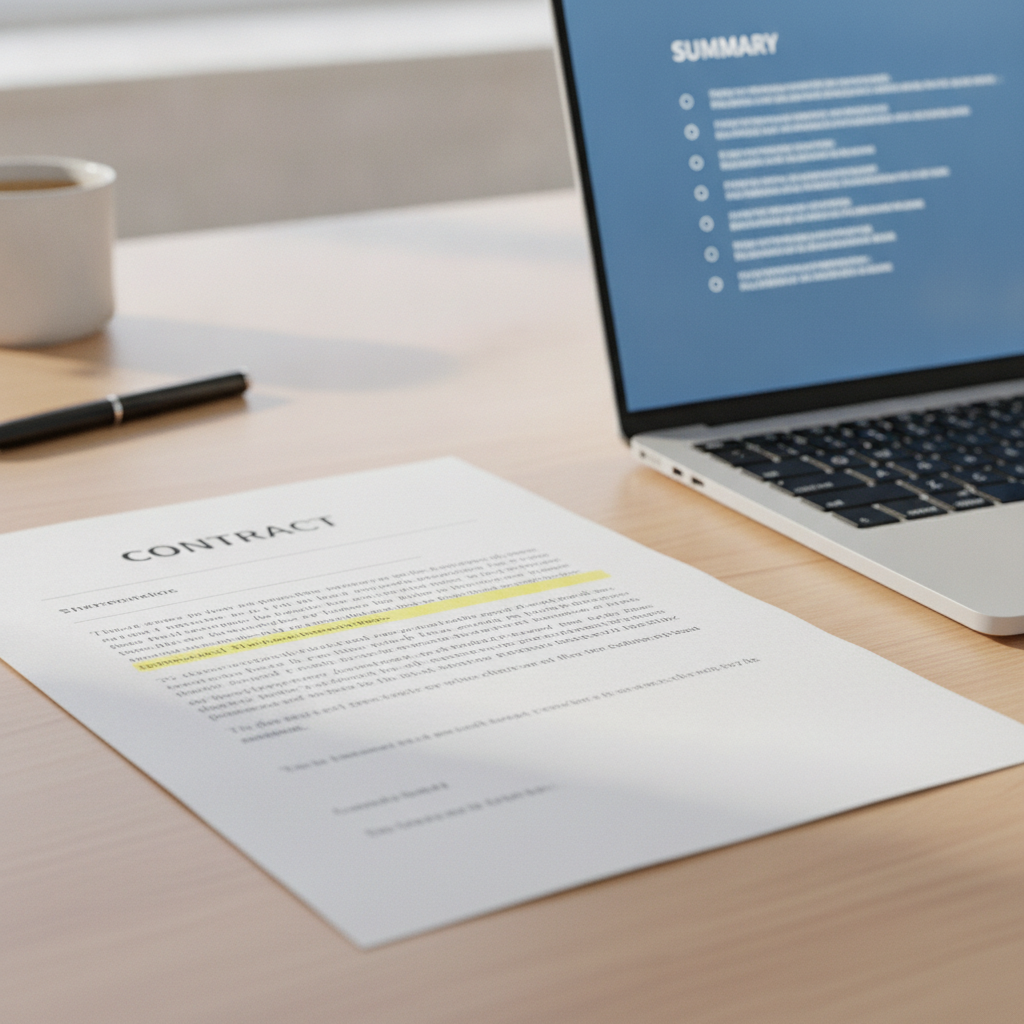
Plain-English summaries. Hand a forty-page commercial lease to a capable AI and ask it to summarize the key commercial terms. You'll get a readable two-page digest in under a minute. Not legal advice — a reading aid. The difference matters, but the reading aid is still valuable.
Extracting the numbers and dates that matter. Term length, renewal dates, notice periods, payment terms, price escalation clauses, penalty provisions — AI is fast and thorough at pulling these out. It won't get bored halfway through page 22 the way you will.
Flagging unusual clauses. An AI trained on a broad range of commercial contracts can tell you when something looks non-standard. "The indemnity in clause 14 is broader than typical — it covers losses arising from your general business operations, not just those directly caused by this agreement." That's useful. It's not a legal opinion, but it tells you what to look at.
Comparing versions. You signed an agreement with a supplier last year. They've sent a "minor update." AI can do a clause-by-clause comparison and list every substantive change. This is one of its strongest use cases — it's faster and more reliable than a human doing the same task, and the risk of missing something important drops significantly.
Generating your question list. This is the most underrated application. Before you spend an hour of a lawyer's time, use AI to produce the list of things that need explaining or negotiating. You arrive informed. The lawyer spends their time on judgment, not orientation. That's where the economic case for this becomes obvious.
A Worked Prompt Pattern
The difference between useful AI contract review and useless AI contract review is mostly in how you ask.
Bad: "Is this a good contract?"
The AI will produce something that sounds thoughtful and is almost entirely generic. It cannot tell you whether this contract is good for your situation, your negotiating position, or your jurisdiction.
Better prompts:
- "List every date and deadline in this agreement and identify who is responsible for each action."
- "Summarize the payment terms, including any late payment penalties or interest provisions."
- "List any clauses that give either party the right to terminate early, and what notice is required."
- "Are there any automatic renewal clauses? If so, what is the notice period to opt out, and by what date would I need to act?"
- "Identify any price escalation or CPI adjustment clauses and explain how they work."
- "What does this agreement say about intellectual property ownership?"
- "Compare this version against the version I'm providing separately and list every clause that has changed, been added, or been removed."
- "Based on this agreement, generate a list of questions I should raise with my solicitor before signing."
That last one is particularly powerful. A good AI will produce a targeted, contract-specific question list — not a generic checklist you could find on any legal blog.
The prompting guide for getting better answers from AI goes into more depth on how to structure questions like these across other business contexts.
What AI Cannot Do — and This Is the Hard Line
Here is where I want to be direct, because the failure modes here are not minor.
It cannot tell you whether a clause is enforceable. Enforceability depends on jurisdiction, local statute, recent case law, and sometimes the specific facts of your situation. An AI might tell you what a clause says. It has no way to tell you what a court in your state or country would actually do with it.
It cannot catch what the contract doesn't say. This is the bigger risk. A missing indemnity, an absent limitation of liability cap, a termination right that nobody thought to include — AI reads the document in front of it. It cannot reliably tell you that something important is absent unless you specifically ask, and even then, it has no way to know what's customary for your specific type of deal in your jurisdiction.
It cannot assess your negotiating position. Whether you should push back on a clause depends on how much you need this deal, what alternatives you have, and how the counterparty is likely to respond. AI has no view on any of that.
It cannot interpret genuinely adversarial language. When a contract has been drafted to obscure its meaning — drafted by a sharp counterparty lawyer who knows exactly what they're doing — AI will often take the words at face value. A human lawyer will read the same clause and recognize the trap.
It cannot give you legal advice. To be explicit about what this article is: nothing here constitutes legal advice, and neither does anything your AI assistant produces. For anything with meaningful financial or legal consequence, you need a qualified lawyer. AI changes the economics of that conversation; it doesn't replace it.
Before You Upload Anything: The Privacy Question
One thing owners often don't think about before pasting a supplier NDA or a commercial lease into an AI tool: are you allowed to?
Many contracts contain confidentiality clauses that restrict who can see the document — and it's not obvious that uploading to a third-party AI platform complies. Some AI tools use your inputs to train their models. Some don't. The terms vary, and they change.
Check the terms of service of any tool you're using before you paste a confidential third-party document into it. The data privacy piece on what happens to information you share with AI tools covers this in detail — it's worth reading before you make this part of your standard process.
As a practical rule: if you're unsure about the tool's terms, redact the counterparty's name and any identifying details before uploading. The AI can still summarize and flag issues without knowing who the other party is.
This is also relevant if you're thinking about using AI for compliance-sensitive processes more broadly — the AI compliance piece covers where the rules get meaningful for small businesses in particular.
The Economics, Honestly Stated
AI contract review doesn't replace legal counsel. What it does is change when legal counsel is worth buying.
Right now, a lot of business owners skip legal review entirely because the math doesn't work. A $6,000 equipment lease doesn't justify $600 in legal fees. So they sign without really understanding what they're signing.
With AI, a 20-minute review of that lease will surface the payment escalation clause, the automatic three-year renewal with a 90-day opt-out window, and the question about liability for damage during transit — all of which the owner can now evaluate. Maybe they decide those risks are acceptable and sign anyway. Maybe they call a lawyer to address the one clause that actually worries them. Either way, they're signing with their eyes open, not just hoping for the best.
For more complex agreements — commercial leases, supplier contracts with volume commitments, customer master service agreements — the question list AI generates can make a one-hour lawyer review genuinely productive instead of mostly explanatory. That changes the economics of getting proper advice.
What This Looks Like in Practice
A few scenarios where this approach is practical:
Supplier agreement renewal. Your freight carrier sends a new rate card and updated terms. Ask AI to compare against last year's version, extract all rate and minimum commitment changes, and flag any new liability or indemnity clauses. Ten minutes of work surfaces what matters.
Commercial lease review. Before you pay a property lawyer, use AI to extract every date (commencement, rent reviews, option exercise windows, make-good obligations), all outgoing costs you're responsible for, and any unusual landlord rights. You arrive at the lawyer with a list of specific concerns rather than starting from scratch.
Subcontractor agreement. A new subcontractor sends their standard terms. Ask AI to summarize the payment terms, flag any IP ownership clauses, extract termination rights, and identify anything that looks non-standard. If it flags something, that's worth ten minutes with a lawyer. If it doesn't, you have more confidence in signing.
Customer MSA. You're a service provider and a new corporate client sends their standard master services agreement. Ask AI to identify all limitations on your scope of work, any audit rights the client has, the IP ownership position, and the liability cap structure. You'll know what questions to raise before the negotiation call.
The Short Version
AI is a useful reading aid for contracts. It summarizes, extracts, compares, and flags. It generates good question lists and makes a lawyer's time go further.
It does not replace a lawyer. It cannot assess enforceability, catch missing provisions, account for your local law, or interpret adversarial drafting. Treat its output as a starting point, not a conclusion.
Check your tool's privacy terms before uploading anything confidential. Redact counterparty names if in doubt. Ask specific questions, not general ones.
And when the contract is genuinely consequential — get a lawyer. AI just helps you arrive better prepared.
If you're thinking about where AI fits into how your business handles supplier relationships, contracts, and operational risk — and you want a practical view rather than a vendor pitch — let's talk. A strategy conversation costs you nothing and usually surfaces something useful.