
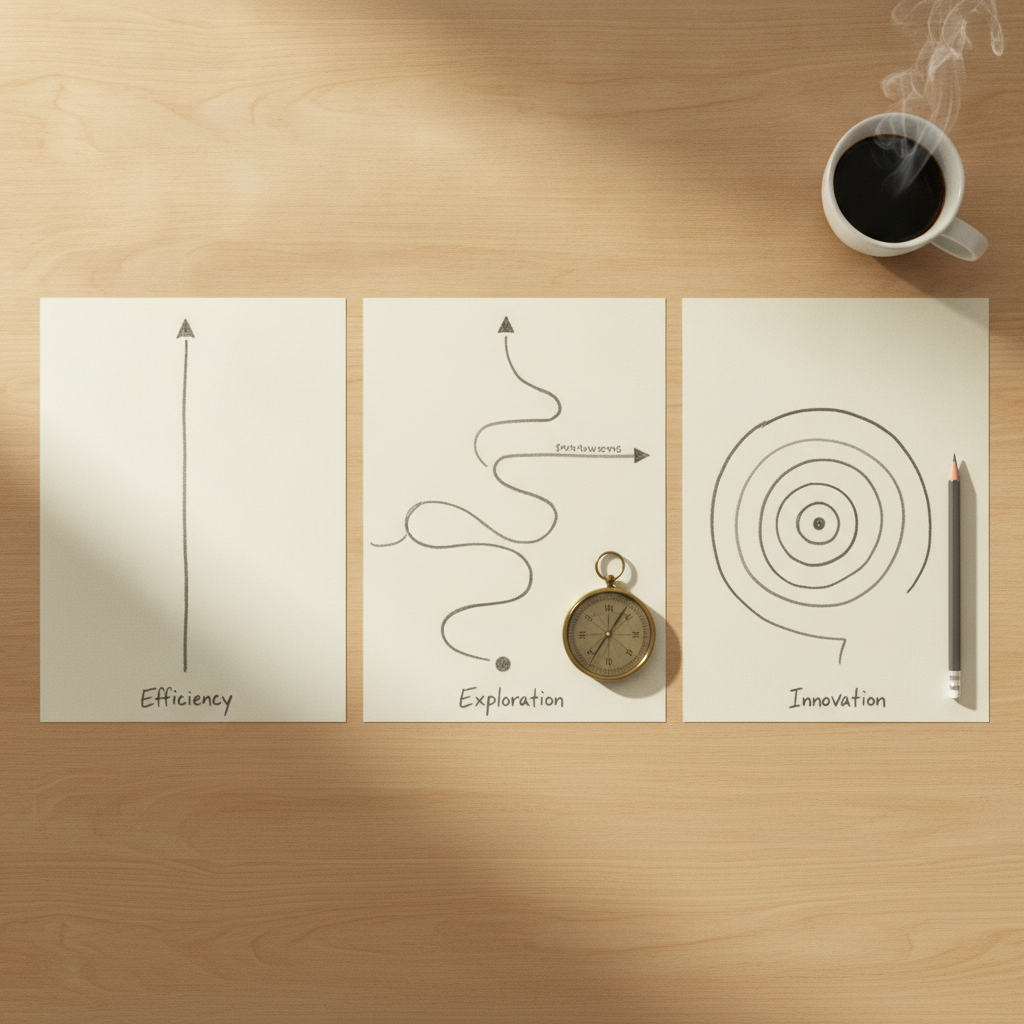
Someone pitches you an AI idea — maybe it's your ops manager, maybe it's a vendor, maybe it's a thought you had at 11pm reading an article like this one. And the question underneath every AI conversation is always the same: is this actually worth doing, and if so, how?
The "how" usually collapses into three options: buy an off-the-shelf tool, build something custom, or hold off entirely. Each one has a legitimate case. Each one also has a way to go badly wrong. What's missing for most business owners is a clear framework for choosing — something that doesn't require a computer science degree or a $30,000 consulting engagement to apply.
This is that framework.
First: What Problem Are You Actually Solving?
Before you evaluate build vs. buy vs. wait, you need to be honest about the problem. AI decisions go sideways early when the problem is vague — "we want to be more efficient" or "our competitors are using AI" — because you end up evaluating tools before you've defined what success looks like.
A good problem statement is concrete: We spend 12 hours a week manually sorting customer support emails into categories before routing them. That work is repetitive, error-prone, and delays our response time.
That's something you can actually solve. "Get smarter about AI" is not.
If you don't have a specific, painful, measurable problem, the right answer is almost always wait — not because AI isn't useful, but because without a clear target you'll spend money and end up with a solution in search of a problem. It's the single most common reason AI projects quietly fail.
The Buy Option: Fast, Affordable, and Usually Right
Off-the-shelf AI tools — think software with AI built in, or purpose-built platforms for a specific workflow — are the right starting point for most SMBs most of the time. Here's why.
Speed. A bought tool can be running in days or weeks. A custom build takes months at minimum.
Cost. A SaaS AI tool might run $50–$500/month. A custom build might run $30,000–$150,000+ to develop, plus ongoing maintenance. That's not a rounding error.
Proven value. Good off-the-shelf tools have been tested across hundreds or thousands of businesses. The rough edges are mostly worn down. The integrations exist. The documentation is written.
Where buying makes sense:
- The problem is common across businesses (scheduling, customer support, document summarization, sales outreach, bookkeeping)
- You want to validate whether AI actually helps before committing more resources
- Your team doesn't have technical depth to build or maintain custom software
- Speed to value matters more than perfect fit
Where buying breaks down:
- The tool does 80% of what you need but the other 20% is genuinely critical — and there's no workaround
- Your workflow is unusual enough that generic tools consistently misfire
- The vendor's roadmap doesn't match your direction and you're building around their limitations
One thing to evaluate carefully with any bought tool: lock-in. If you run two years of customer data through a platform and they double prices or get acquired, what's your exit? Check data portability before you commit — it's one of the costs nobody warns you about until you try to leave. It's rarely discussed in sales calls and almost always matters later.
The Build Option: Control, Fit, and a High Bar to Clear
Custom AI development means paying someone — a developer, an agency, or an AI consultancy — to build something specifically for your business. It could be a custom model, a fine-tuned version of an existing model, a bespoke automation workflow, or an internal tool that ties your systems together in a way no off-the-shelf product does.
The appeal is real: you get exactly what you need, you own it, and you're not dependent on a vendor's pricing or priorities.
But the bar to justify it is high, and most SMBs clear it less often than they think.
Build makes sense when:
- Your workflow, data, or competitive advantage is genuinely unique — not just "a bit different," but different in ways that materially affect outcomes
- You've already tried one or two off-the-shelf options and confirmed the fit problem isn't fixable
- The ROI math works even with realistic build costs (not optimistic ones)
- You have, or can hire, someone to maintain it — because software is never done
The costs people underestimate:
- Build time. Three to six months for a serious custom tool is common. Twelve months isn't rare.
- Iteration. V1 rarely works the way you pictured. Budget for V2.
- Maintenance. AI tools drift. Models update. Your data changes. Someone has to keep it working.
- Opportunity cost. While you're building, your team is distracted and that off-the-shelf tool your competitor bought last quarter is already running.
A useful gut-check: if a vendor built exactly the tool you're imagining and sold it to you for $500/month, would you buy it? If yes, keep looking — it might already exist or be close enough. If no — because your situation genuinely wouldn't be served by that — then a custom build has a case.
The Wait Option: Underrated and Often Correct
Waiting feels like inaction, but it's a legitimate strategic choice. The AI tooling landscape is moving fast enough that a category that has no good options today may have three solid ones in six months.
Wait makes sense when:
- The problem is real but not urgent — it's not bleeding money or costing you customers
- The available tools are early-stage and rough (common in niche verticals)
- Your team is already stretched and an AI project would create distraction without enough payoff
- You're not sure the problem is actually worth solving — some "inefficiencies" are cheaper than the effort to fix them
Waiting also buys you information. Watching how a category of tools matures, what early adopters report, and where the real-world pain points are is genuinely useful. You'll make a better decision in nine months with that data than you will today without it.
The risk of waiting is real too: some competitive advantages compound, and a competitor who automates customer follow-up today and frees their sales team to focus on closing has a head start you'll have to work to overcome. So waiting should be a deliberate call, not a default.
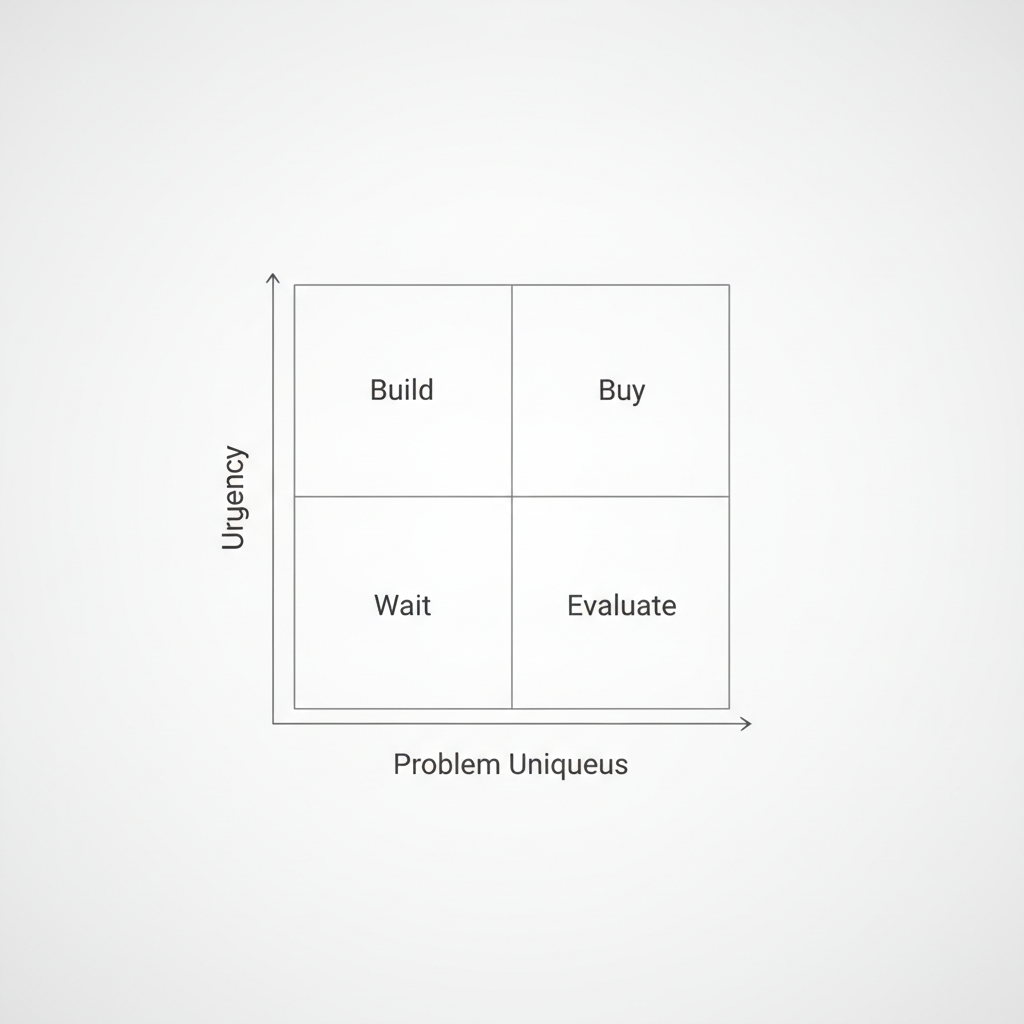
The Decision Matrix: Four Questions That Tip It
Run any AI opportunity through these four questions before you decide.
1. How unique is the problem?
Common problem → lean toward buying. Genuinely unique workflow → build has more of a case.
2. How urgent is it?
Costs you real money or customers now → buy or build, decide fast. Nice-to-have → wait is fine.
3. What does the math look like?
Estimate the annual cost of the problem (hours × loaded labor cost, or lost revenue). Estimate the cost and timeline of the solution. If the solution pays back in under 18 months, it's probably worth it — the crux of telling whether an AI tool is worth the money. If it's 3+ years, think harder.
4. Do you have the capacity to absorb a project?
Even a bought tool requires time to implement, train your team, and integrate with your systems. A custom build requires significantly more. If your team is already overloaded, even a good project can fail from poor adoption.
A Note on Hybrid Approaches
These three options aren't always mutually exclusive. A common smart path: buy first, build later.
Start with an off-the-shelf tool to validate that the AI approach actually works for your problem and your team. Once you've proven the value and understand exactly where the tool falls short, you have the information you need to build something targeted — and you're building on real experience, not assumptions.
This is slower than going straight to custom, but it's dramatically less risky. The graveyard of SMB software projects is full of custom builds that solved a problem no one fully understood yet.
What Good Judgment Here Actually Looks Like
The businesses that get this right tend to share a few habits:
- They start with the problem, not the technology
- They're honest about what "unique" means — most workflows are more common than they feel from the inside
- They run the ROI math before the sales call, not after
- They treat the first tool as a test, not a commitment
- They factor in the ongoing cost of maintenance, not just the build cost
The businesses that get it wrong tend to either jump to custom builds too fast (because off-the-shelf feels like a compromise) or avoid AI entirely because no single tool seems perfect (because nothing is).
The right call is almost always somewhere practical in the middle — and it changes as your business changes, as the tools mature, and as you learn more about what AI can and can't do for your specific situation.
Choosing the right path between build, buy, and wait is exactly the kind of decision we work through with clients at Blueprint AI Strategy — before any money is committed or any vendor is called. If you'd like that kind of thinking applied to your business, book a strategy call and we can start with the problem, not the pitch.