

The Customers Who Don't Cancel — They Just Disappear
Nobody called to say goodbye. There was no complaint, no angry email, no cancellation notice. One day they were a regular account; at some point they stopped ordering; and because there was no event to flag, nothing in your workflow surfaced it. They are just quietly gone.
This happens in almost every business that sells to repeat customers. A restaurant supply company loses a café that used to order weekly. A bookkeeping firm loses a client who hasn't sent files in five months. A landscaper who serviced a property every spring simply doesn't get a call this year. Each of those ex-customers made a decision — but they didn't announce it, and you didn't notice.
The business case for fixing this is usually stronger than any new-lead campaign. These people already bought from you. They already trusted you once. Your records already exist. The cost to win one back is a fraction of what it costs to acquire a new customer from scratch, and the close rate is almost always higher. The problem is finding them — and then knowing what to say.
AI doesn't solve the whole problem, but it earns a real place in two specific parts of it: identifying who's gone quiet and helping you approach them sensibly. Here's how to do it, in the order the work actually happens.
Step 1: Define "Lapsed" for Your Business — This Is the Real Thinking
Before you pull a single report, you need a definition of lapsed that makes sense for your business model. This is a human judgment call, not a number AI gives you.
The mistake most owners make is picking a round number — "no purchase in 90 days" or "no purchase in a year" — and applying it to everyone. That produces garbage. A 90-day rule makes sense for a food distributor with weekly ordering accounts. It will flag every single client of a roofing company, where a three-year gap between jobs is completely normal.
The more useful definition is: later than their own normal gap.
A customer who bought from you every six weeks, and hasn't bought in five months, is lapsed. A customer who bought once a year, and it's been fourteen months, is lapsed. A customer who bought every three years is probably fine. "Lapsed" is a deviation from their individual pattern, not a threshold you invented.
To apply this, you need to know two things for each customer: their typical reorder interval and their last purchase date. With that, you can calculate how overdue each account is — and sort by urgency accordingly. More on how AI helps with that calculation in a moment.
There are also customers who appear lapsed but aren't worth contacting. You may know that a client went out of business, moved away, was a one-time project that was always going to be one-time, or left on terms that would make a reactivation call awkward. Keep a mental (or literal) exclusion list before you run any campaign. AI will not know any of this.
Step 2: Get the List Out of Wherever It Lives
This is where most of the effort actually goes, and there's no shortcut around it.
Your customer purchase history is probably in one or more of the following: your accounting software (QuickBooks, Xero, FreshBooks), your point-of-sale system, your booking platform, a CRM, or a spreadsheet that has evolved over several years and contains some columns that nobody remembers creating. It may be in multiple places.
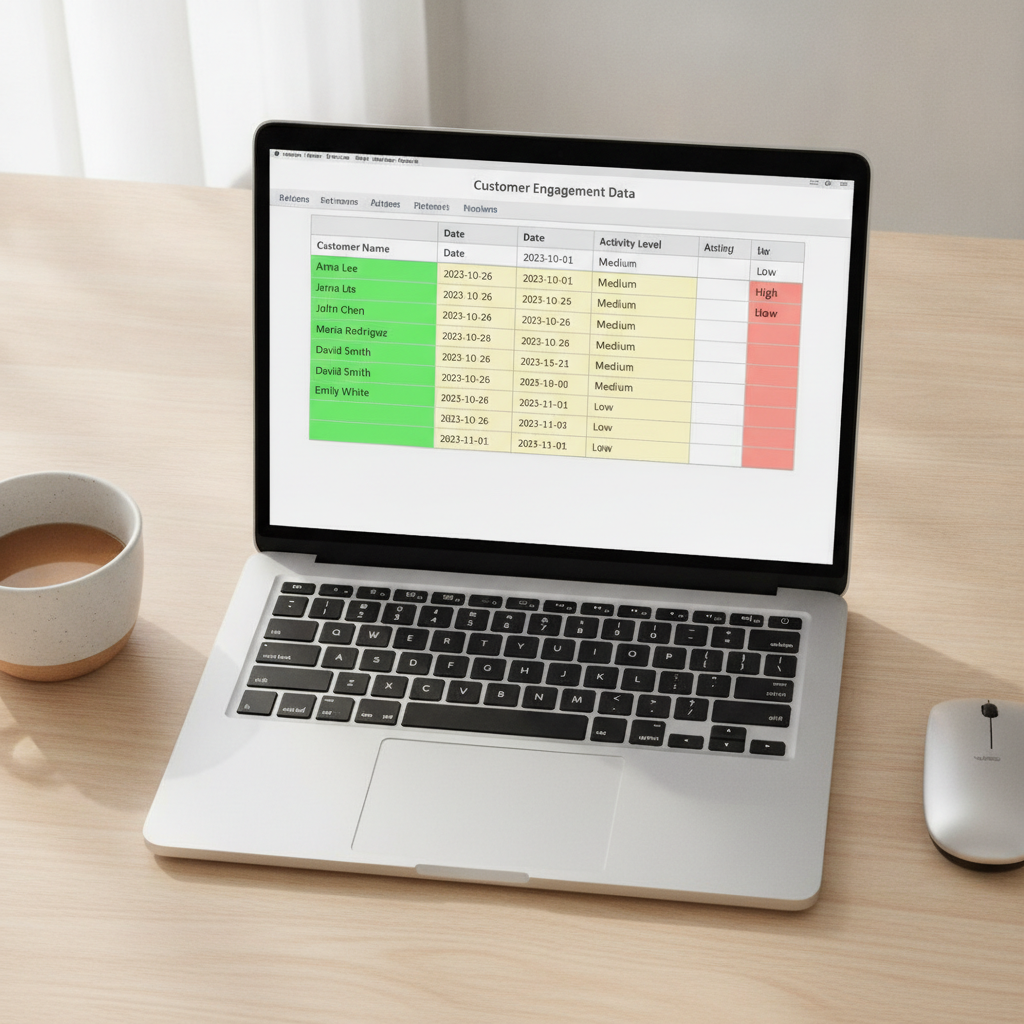
What you need, at minimum, is a flat export with: customer name, date of each transaction (or at least the most recent one), and some rough sense of transaction frequency or count. If you can also pull average order value, that's useful for prioritization. Phone number or email for outreach comes later.
Getting this into a form you can work with is unglamorous work. If your data is reasonably clean and consistent, it might take an afternoon. If you've had staff turnover, system migrations, or years of manual entry by people who spelled company names differently each time, it will take longer — and some of what AI can do is help you clean and consolidate it, which is covered in more detail in the article on getting your data ready for AI.
Export what you have. Don't wait until the data is perfect; it never will be. A messy list you act on is worth more than a clean list you're still planning.
Step 3: Where AI Actually Earns Its Place
Once you have a workable export, AI starts doing useful things. Here are the four where it genuinely helps.
Cleaning and sorting the raw data
If your export has inconsistent formatting — different date formats, the same customer listed under three slightly different names, columns that got shifted — an AI tool (ChatGPT, Claude, or even the AI built into Excel or Google Sheets) can help you standardize it. Ask it to normalize date formats, flag duplicate entries, or split a "full name" column into first and last. This is not glamorous, but it's real time saved.
Calculating each customer's overdue status
If you can get a table with customer name, order dates, and frequency, you can ask an AI to calculate: what was the average interval between purchases for each customer, and how many days past that interval is today? That gives you an "overdue by" number for each account, which is far more meaningful than a flat 90-day cutoff. Sort by that number and you have a prioritized list — the most overdue relative to their own pattern at the top.
Spotting patterns in who lapses and when
Feed AI a list of lapsed customers alongside any attributes you have — business type, location, product category, first purchase year, account size — and ask it to describe what they have in common. You might learn that your lapsed accounts skew heavily toward a particular industry segment, or that customers who only ever bought one product category rarely return, or that attrition tends to cluster after a specific event (a price change, a staff change, a season). This kind of pattern is easy to miss when you're looking at individual records; it's easier to see across a whole dataset.
That said: be appropriately skeptical. AI will find patterns whether or not they're meaningful, and a sample size of eight "lapsed bakery clients" is not a pattern, it's a coincidence. The larger your dataset, the more useful this analysis is.
Segmenting the list and drafting approaches for each group
Once you have a rough sense of your lapsed customers — high-value versus occasional, long-lapsed versus recently quiet, different product categories — you can ask AI to help you draft outreach for each group. This is where it does its clearest, most useful work.
Give it context: who you are, what the segment looks like, what you're trying to accomplish, and what tone fits your business. Ask for a short, direct email or a call script — not a marketing blast, but something that sounds like a person who noticed they hadn't heard from another person in a while. Let AI draft it, then edit it until it actually sounds like you.
This is essentially the same workflow covered in the AI for sales follow-up guide, adapted from new leads to old customers. The prompting approach is the same; the message just needs to acknowledge history rather than introduce yourself fresh.
A useful starting prompt looks like this:
"I run a commercial cleaning company. I'm reaching out to a client we serviced monthly for about two years who stopped booking eight months ago with no explanation. We've never had a complaint from them. Draft a short, friendly email that acknowledges the gap without being needy, and invites them to get back in touch. Keep it under 150 words."
That's the kind of specificity AI responds to well. Vague inputs produce generic outputs. The more context you give about your business, the client, and your relationship, the better the result.
What AI Cannot Do Here — Be Clear-Eyed About This
AI cannot tell you why a customer left. It can speculate, and it will do so confidently if you ask it to — which is a problem, because confident speculation is exactly what you don't want driving your outreach strategy. If you ask "why do you think this client stopped ordering?", you'll get plausible-sounding guesses based on nothing. Don't anchor your approach on that.
The honest answer is: you usually don't know why they left, and your outreach strategy should account for that uncertainty. Don't assume bad service, don't assume price sensitivity, don't assume they went to a competitor. A light, no-assumption reactivation message ("we noticed we haven't connected in a while — wanted to check in") leaves room for whatever the real reason turns out to be.
AI also cannot tell you what to offer. Whether a discount makes sense, whether a conversation is better than an email, whether this particular account warrants a personal call from you rather than a message from your admin — those are judgment calls that depend on relationship history, margin, and what you're trying to build. AI can draft the version with a discount and the version without one; you decide which to send.
The AI-and-customer-research pairing is useful for pattern spotting. But as noted in the customer feedback analysis piece, AI is good at finding patterns across many data points and bad at explaining the reasons behind individual behavior. Use it for the former; reserve the latter for conversations with actual humans.
The Judgment Calls That Stay Human
A few decisions AI should not be making:
Who not to contact. Customers who left in difficult circumstances, clients you know went out of business, accounts where the relationship ended badly — these shouldn't be on the list at all. Filter them before you export, or at least before you send anything.
What to offer. A discount is a common instinct for lapsed customer reactivation. It sometimes works. It also trains customers to disappear and wait for an offer. Whether to discount, and how much, depends on your margins, your volume goals, and what you know about the relationship. That's an owner decision.
Whether a message is appropriate at all. A lapsed customer list is still a marketing list, and the rules that apply to marketing lists apply here. If these are consumers rather than business accounts, you need to be mindful of unsubscribe obligations and consent requirements. Depending on your location and industry, email marketing regulations (CAN-SPAM in the US, CASL in Canada, GDPR in Europe) may govern exactly how you can reach out. The AI regulation article covers the landscape, but if you're in a regulated industry or marketing to consumers in the EU, check with someone who knows the rules before you send.
What success looks like. Decide in advance what you're measuring: response rate, booked calls, orders placed, revenue recovered. Without a definition of success, you can't tell whether the project worked — and you can't improve the next one.
A Realistic Picture of the Effort and the Return
This project is not free, but it's also not a major undertaking. The realistic shape of it:
- Data pull and cleaning: a few hours to a day, depending on the state of your records.
- Defining lapsed and building the prioritized list: a few hours, including the AI-assisted calculation of overdue status.
- Segmenting and drafting outreach: a few hours in a tool like ChatGPT or Claude, with your own editing on top.
- Sending and tracking: depends on your volume, but manageable.
The return varies enormously by business. A professional services firm with ten well-chosen lapsed accounts might recover two or three engagements from a single well-crafted outreach. A supplier with a long customer list might find dozens of reactivatable accounts in the top tier alone. The math usually pencils out well — especially compared to the cost of acquiring new customers from cold.
The businesses that get the most from this are the ones who treat it as a regular practice, not a one-off. A quarterly pass through your customer records — who's gone quiet that shouldn't have? — is a sustainable rhythm that costs very little once you've built the workflow once.
Getting Started
If you've never run a lapsed customer analysis before, start small. Pull the last two to three years of customer data, define what "lapsed" means for your specific business, and sort by overdue status. Take the top fifteen or twenty accounts, think about whether there's anything AI can tell you about their patterns, and draft a short outreach per group. Send it, track what happens, and refine the process for next time.
The customers are already in your records. The data already exists. The relationship is already warmer than any cold prospect you'll ever reach. It's worth an afternoon to find out who's slipped away quietly — and whether they'd come back if you asked.
If this is the kind of systematic thinking you want applied to your customer base and your data, book a strategy call — we can talk through what's realistic for your business specifically.