

There's a number missing from almost every AI productivity conversation, and it's the one that decides whether AI is actually saving your business money or just moving the work around.
The missing number is review time.
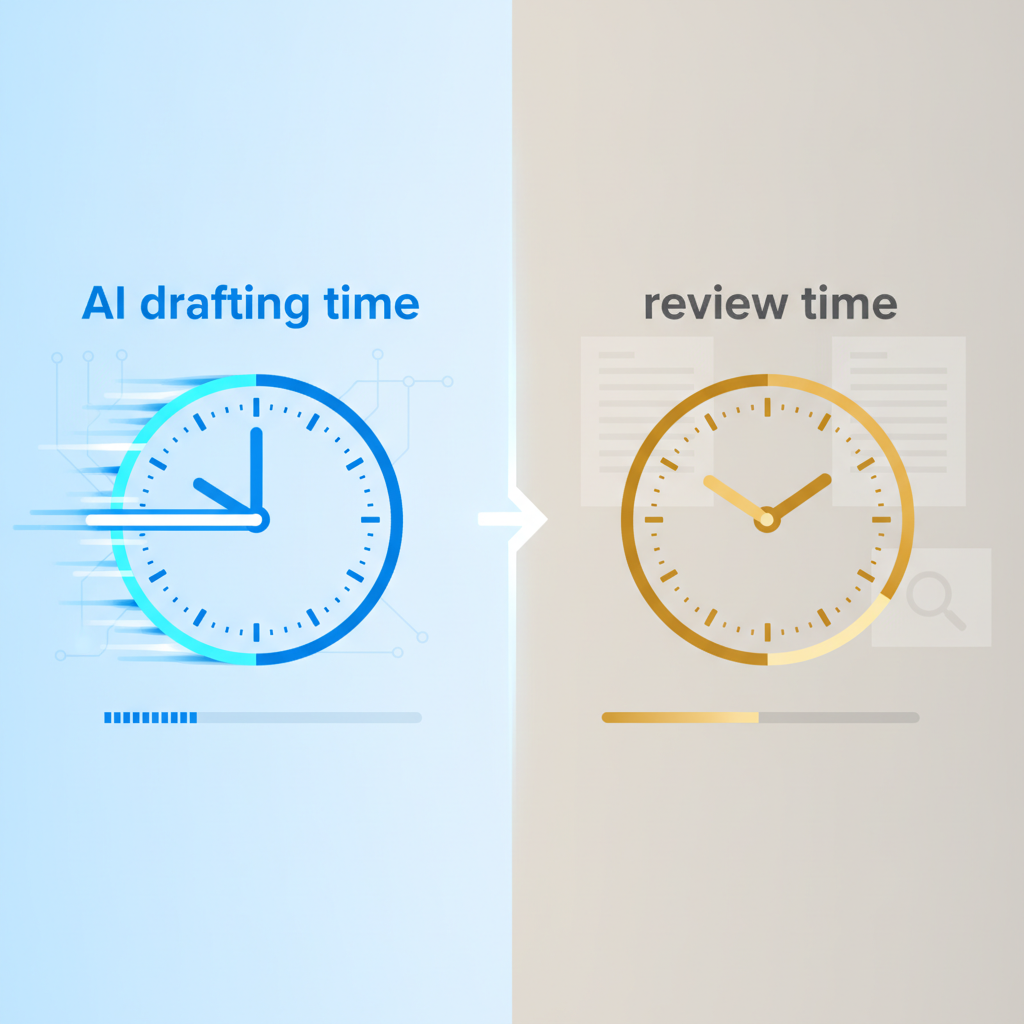
AI can produce a serviceable first draft of a client email, a project summary, or a marketing paragraph in roughly ten seconds. That speed is real. What also tends to be real: the ten, fifteen, or twenty minutes someone on your team spends reading that draft, fixing the parts that are subtly wrong, removing the sentence that sounds nothing like you, and catching the claim the tool invented with complete confidence.
Add that time back in, and the math often looks very different.
Why Review Time Gets Ignored
It gets ignored for a straightforward reason: it doesn't feel like a cost. It feels like a quick check.
When someone spends forty-five minutes writing an email from scratch, everyone can see the time going somewhere. When someone asks AI to write the email and then spends twenty minutes cleaning it up, those twenty minutes tend to get mentally filed under "polishing" — almost invisible, definitely not attributed to the AI task.
But it is a cost. Someone's attention, at whatever that person costs the business per hour, went into that review. If the review is happening every day across several team members, it adds up fast.
The irony is that the faster AI gets at producing drafts, the worse this problem can become. Speed encourages volume. If it used to take your team one hour to produce three pieces of marketing copy, they might produce eight with AI — but if each one still needs fifteen minutes of review, you've traded one hour of writing for two hours of reviewing. Net result: you've made the job slower and added cognitive load on top.
How to Measure Your Review Time Honestly
You don't need a sophisticated tracking system. You need one week of honest observation.
Pick a task where your team regularly uses AI output — a category of emails, a weekly report, social media posts, whatever it is. For each piece of work, record two times: when the AI delivered the draft, and when the person finished reviewing and approved it. The gap between those two numbers is your actual review cost.
Most business owners who do this are surprised. Not because the numbers are catastrophic, but because they've never looked. A fifteen-minute average review on a task you run fifty times a month is twelve and a half hours of someone's time. Whether that's worth it depends on what writing those fifty things from scratch would have taken — but you can only answer that question if you know both sides of the equation.
A cleaner version of the same exercise: have one person write something without AI for a week and time them, while another person uses AI for the same type of task and times everything including review. Compare. The result is almost always more nuanced than either "AI is faster" or "AI is not faster."
The Spectrum: Heavy Checking to Light Checking
Not all AI output needs the same level of scrutiny. Understanding where a task falls on this spectrum is the most practical thing you can do to manage review costs.
Light checking — mostly safe to trust after a quick read:
These are tasks where the stakes of an error are low, the output is formulaic, and you can verify correctness at a glance.
- Internal meeting summaries
- First-draft bullet points for your own planning
- Rough schedules or agendas
- Simple FAQ entries about non-technical topics
- Social posts that are promotional rather than factual
For this category, a thirty-second scan is often enough. If something sounds off, you'll catch it quickly because you know the territory.
Medium checking — needs real attention but not line-by-line scrutiny:
These are tasks where errors would matter but are unlikely to be catastrophic, and where you're mainly checking for tone, accuracy, and brand fit.
- Client-facing emails
- Blog posts or website copy
- Job listings
- Proposals (first draft)
- Customer-facing FAQs
Here you should read the whole thing, not just skim. Budget five to ten minutes per output, more if the subject matter is specialist.
Heavy checking — needs expert eyes, every time:
These are tasks where a confident error from an AI could cause real harm: to a client relationship, to your legal exposure, to someone's safety. Matching the depth of review to the size of the risk is the core idea behind NIST's AI Risk Management Framework, which is worth skimming if you want a more formal way to think about it.
- Any document that contains numbers, dates, or figures someone will act on
- Legal or contract language
- Technical specifications or instructions
- Anything involving compliance, regulation, or insurance
- Medical or financial guidance, even informal
For these tasks, assume the AI will produce something that sounds authoritative and contains at least one thing that's wrong or incomplete. That's not pessimism — it's how these tools work. They are very good at sounding right. They are not designed to be accurate. The article AI Will Confidently Get Things Wrong — Here's How to Catch It goes deeper on the mechanics of why, which is useful reading before you hand anything high-stakes to a language model.
The key question to ask before assigning a task to the heavy-checking category: "Would I notice if this output were wrong?" If the answer is "only after a careful read by someone who actually knows this area," that's a heavy-checking task, and the review time needs to be budgeted accordingly.
When Review Costs Outweigh the Savings
There are a few patterns where AI almost always produces a net-negative result once you account for review time.
Specialist knowledge tasks. If reviewing the AI's output requires someone with deep expertise — a lawyer checking contract language, a structural engineer reviewing load calculations — the review isn't quick. It's almost as time-consuming as writing the thing correctly from scratch. AI might shave a little time off the front end. It might add confusion and rework to the middle.
High-volume, high-variation tasks. AI saves time on repetitive work because the same instructions work across many outputs. But if every piece of output requires different knowledge to verify, volume doesn't help you — it just means more reviews, each of which is genuinely complex.
Tasks owned by someone who doesn't read the output. This is more common than it sounds. A manager asks AI to write something, briefly skims it, and sends it under their name. The review didn't happen — it just looked like it did. The errors travel with the output. This is less a cost problem than a risk problem, but it starts with the same habit: treating the output as mostly right by default.
Anything involving your business's specific numbers, policies, or history. AI doesn't know what you've actually quoted a client, what your current return policy says, or what exception you made three months ago. When the output touches those specifics, review stops being about grammar and becomes about factual accuracy — a much slower, more effortful process. This is connected to a broader point about getting AI answers that actually reflect your business, which depends heavily on what information you give the tool to work with.
How to Decide Whether a Task Is Still Worth It
A useful mental test, once you've measured your review times honestly:
If I removed the AI from this task entirely, what would change?
If the answer is "we'd spend three times as long on it," keep using AI — even with review overhead, you're ahead. If the answer is "we'd spend about the same amount of time and produce something we trust more on the first pass," that's a task to reconsider. If the answer is "we'd probably spend the same time but involve fewer people and fewer steps," that's worth examining carefully too.
A related question: who is doing the reviewing? If your highest-cost person is reviewing AI output that your lowest-cost person could have written, you may have simply pushed work upward rather than reducing it. That's a workflow design problem, not an AI problem — but AI can create the conditions for it.
This kind of structured thinking about which tasks actually pay off is something many businesses haven't done yet. It's also one of the more common patterns in what a small business keeps, drops, and regrets after two years of AI use — some of the tasks that seemed like obvious wins early on turn out to have hidden review costs that erode the gains.
Making Review Faster Without Skipping It
If a task is worth running through AI but the review is taking too long, the fix is usually in the prompt, not the process.
Better instructions upfront mean less cleanup after. Specifying your tone, your audience, the things you never say, the format you want, and any facts the tool needs to know will shorten review time more than almost anything else. A prompt that takes two minutes to write can save ten minutes of editing on every output it produces.
Another option: add a self-check step to the prompt itself. Asking the tool to flag anything it's uncertain about, or to note where it made assumptions, creates a different kind of output — one that actively surfaces its own weak spots rather than smoothing over them. You still need to verify, but you know where to look.
Finally, for tasks that need heavy checking anyway, it's worth asking whether AI is adding enough to the early part of the process to justify its presence at all. Sometimes it is — structure and a starting point have real value even if every sentence gets rewritten. Sometimes it isn't, and the draft creates a false sense of progress that actually slows experienced people down.
The Honest Bottom Line
AI is genuinely useful for many writing and communication tasks in small businesses. But "AI did it in seconds" and "this task took seconds" are not the same sentence, and conflating them leads to a productivity accounting that flatters the tool more than the outcome deserves.
Measure the full cycle time. Categorize your tasks honestly by how much checking they actually need. And make the call about each task based on real numbers, not the promise of speed.
The businesses that get the most lasting value from AI are the ones that treat review time as a real input — tracked, optimized, and factored into every decision about what to hand off.
If this is the kind of thinking you want applied to your specific workflows and team, book a strategy call and we'll work through it together.